

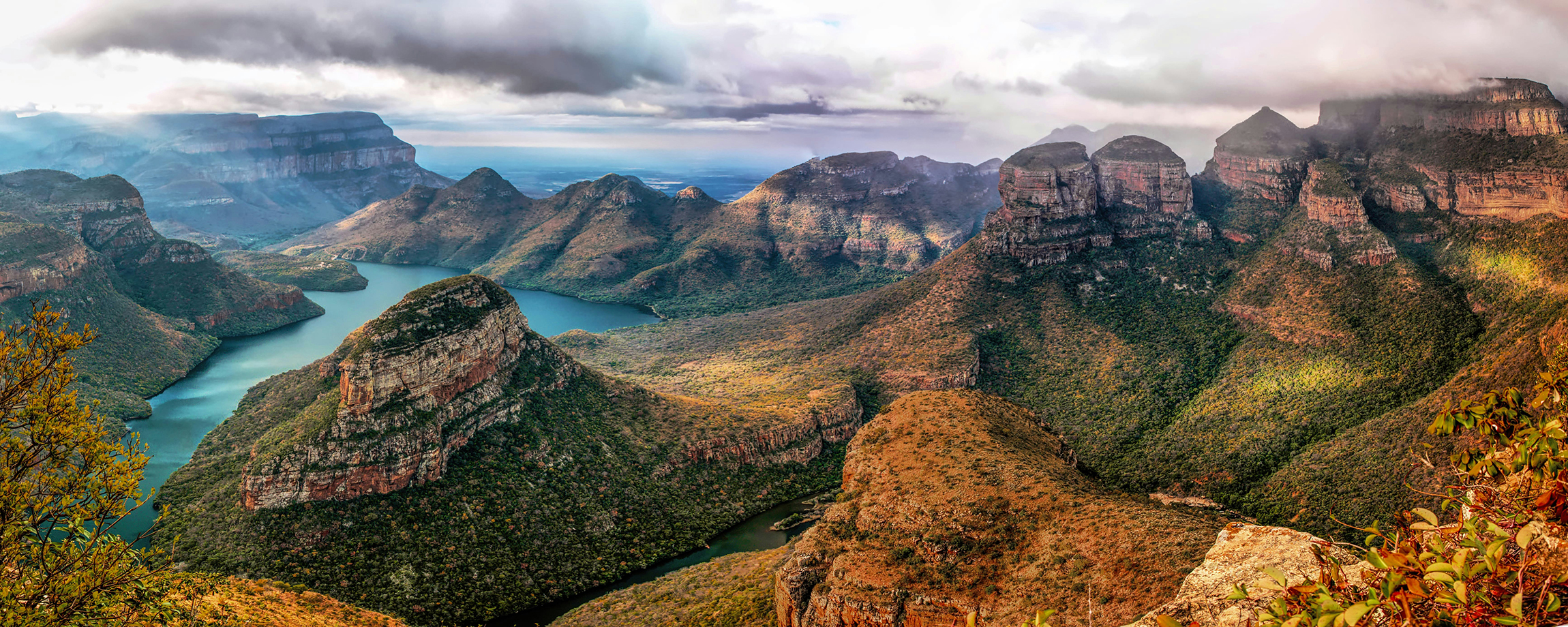
There are few places where the scale of nature feels simultaneously immense and intimate. The Three Rondavels in Mpumalanga are one of them.
Standing at the main viewpoint along the Panorama Route, I was immediately struck by the towering dolomite formations rising from the edge of the Blyde River Canyon. Three rounded monoliths, sculpted over millions of years, they are at once precise and timeless, commanding attention without a single word.
The largest formation, often called the Chief, dominates the scene, flanked by two smaller companions that curve gracefully beside it. Their smooth, conical shapes echo traditional African rondavels, blending human reference with raw geological artistry. Yet these are entirely natural, shaped by wind, water, and erosion over countless centuries. I circled the viewpoint slowly, noting the subtle variations in curve, texture, and colour, each angle offering a slightly different perspective on their enduring form.
Below, the Blyde River threads through a dense mosaic of subtropical vegetation. From this height, the canyon reveals itself in layers: jagged cliffs, steep escarpments, and distant slopes that stretch toward the horizon. The river glimmers like a silver ribbon, reflecting the ever-changing sunlight, while the canyon walls catch shadows that move slowly with the rising sun. Standing there, I could feel the canyon’s rhythm, a quiet, measured pulse, completely separate from the pace of human life.
The light here is transformative. Morning sunlight illuminates streaks of ochre, muted reds, and grey across the dolomite surfaces, highlighting the cracks, ridges, and textures that define each formation. Shadows stretch and shift across the rounded surfaces, tracing their natural curves and indentations, while a gentle breeze stirs the trees along the escarpment, carrying the distant calls of birds and the rustle of leaves echoing against the cliffs. The air is crisp and cool, noticeably fresher than the lowveld below, and it sharpens every detail, the rough texture of the rock, the glint of sunlight on water, the contrast of shadow and light.

I lingered for what felt like hours, observing the formations from multiple angles. There is a patience required here. The Three Rondavels offer, it to those willing to watch, to listen, and to feel the smallest details, a natural groove catching sunlight, a thin mist rising from the river below, or the echo of a bird call bouncing off distant cliffs all become memorable moments.
These formations are not just geological features; they are storytellers. Their names, the Chief and his companions, hint at human recognition of their presence, but the true story belongs to the land. Each curve, crack, and shadow is evidence of erosion, sedimentation, and the patient hand of time shaping the landscape. Observing them, I could not help but reflect on the vastness of this part of Mpumalanga, a region that stretches from the lowveld up to the high escarpment, where subtropical forests, rivers, and cliffs coexist in quiet, dramatic harmony.
Even after leaving, the Three Rondavels linger in the mind. They are monumental yet approachable, commanding yet calm, precise yet organic. Visiting them is not about ticking a box on a travel list; it is about stepping into a landscape that endures beyond human memory and allowing it to reshape your perspective.
For anyone exploring Mpumalanga or following the Panorama Route, the Three Rondavels are more than a viewpoint; they are an experience of scale, time, and quiet majesty. They are a reminder that some landscapes are not just seen but felt, a presence that lingers long after the sun has moved and the shadows have shifted.
