


Bourke’s Luck Potholes are unlike anything else along the famous Panorama Route and are probably the most famous in South Africa.
This is not a single waterfall or a broad scenic lookout, but a living sculpture gallery carved entirely by nature. Over millions of years, the swirling confluence of the Treur and Blyde Rivers has drilled deep, cylindrical shafts into the golden, iron-rich sandstone. These perfectly rounded pools, some small and intimate, others are wide enough to swallow a house, shimmer in a palette of colours that shift with the light: copper, jade, smoky black, pale gold.
From above, the view is hypnotic. The water slides over the lip of one pothole and disappears into shadow before reappearing in another, foaming and swirling as it makes its eternal descent.
In the late 1800s, a prospector named Tom Bourke set his sights on these riverbanks. Gold fever had gripped the region, and the Blyde River Canyon area was drawing miners from far and wide. Bourke staked a claim here, convinced he would strike it rich. History, with its dry sense of humour, records that he never found a speck of gold. But the name stuck, and in a twist of fate, the place that brought him nothing has since become one of South Africa’s most treasured natural wonders, worth far more in beauty than in bullion.
The modern experience is nothing short of spectacular. Well-maintained walkways snake along the cliffs, offering different perspectives: high over the pools, level with the rushing water, and across from canyon walls streaked with black from centuries of mineral-rich spray. Bridges stretch across the chasm, look down, you see the water churning in tight spirals, carrying with it tiny stones and sand these are the very tools nature has used to carve these shapes for millennia.
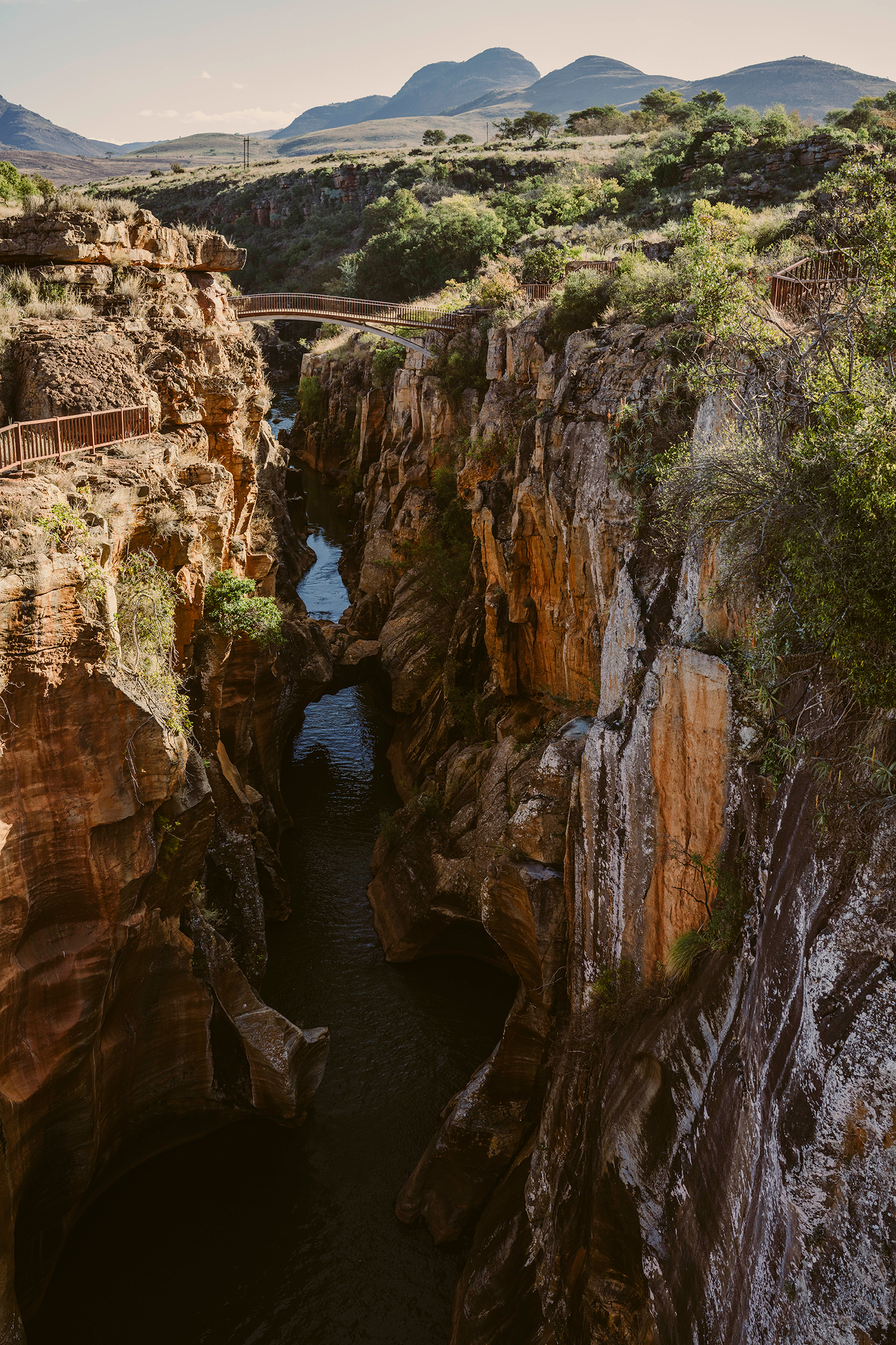

On sunny days, light filters through the water like liquid amber, revealing the sheer smoothness of the walls. In the rainy season, the rivers roar, filling the air with a wild energy that vibrates through your chest. The potholes froth and spill, and the once-placid pools become whitewater whirlpools.
Step back from the railings and the broader scenery comes into view: rolling grasslands dotted with aloes and wildflowers, the distant green shoulders of the Drakensberg escarpment, and just beyond, the yawning expanse of the Blyde River Canyon.
If you listen closely, you can hear more than just the water. Birdsong echoes faintly from the cliffs. The metallic calls of the Cape starling, the liquid notes of sunbirds darting among the blooms. Occasionally, a shadow will sweep across the ground as a Verreaux’s eagle rides the thermals above.
Many visitors see Bourke’s Luck Potholes as a quick photo opportunity before moving on to the next Panorama Route landmark. But linger longer, and it becomes something else entirely. This is a place to slow down, to watch the way sunlight shifts on the water’s surface, to notice how each pothole is subtly different. Some deep and narrow, others shallow and wide, their edges scalloped like the rims of ancient goblets.
The rivers are in no hurry; they have been shaping this place for millions of years and will continue long after we’re gone. Standing there, you’re reminded that time, in its truest form, is both relentless and generous.
Bourke’s Luck Potholes are not just a geological curiosity; they’re a testament to nature’s artistry, a place where two rivers meet and, together, carve the stories of the earth.
